
Love Pictures, Images and Photos
love quote Pictures, Images and Photos

Sunday, November 30, 2008

Global Warming


Global Warming

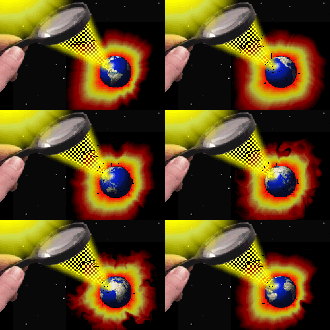
The National Academy of Sciences, a private organization of top scientists that advises the U.S. government on scientific matters, reported on June 22, 2006, that the "recent warmth is unprecedented for at least the last 400 years and potentially the last several millennia" and that "human activities are responsible for much of the recent warming".

The report goes on to say that from the start of the 20th century, there were sharp rises in the "greenhouse" gases, carbon dioxide and methane. These two gases are believed to be the main contributors to global warming, by trapping heat in the Earth's atmosphere, similar to the way that a windshield traps heat in a car.

What is producing enough greenhouse gases to change the climate of our planet? Since the industrial age began, factories, power plants, and cars have burned coal and gasoline. Spitting out an endless stream of carbon dioxide. We produce millions of pounds of methane by allowing our trash to decompose in landfills and from agricultural sources like cattle and fertilizer.

Scientists all over the world agree that humans are the cause of global warming and that it could have catastrophic effects. It is important for all countries to reduce emissions of carbon dioxide and other greenhouse gases now, to limit the future effects of global warming.

As a society, we must break our dependency on fuels that cause pollution by supporting clean, renewable energy sources. Each of us can slow global warming by reducing the amount of energy we use and the pollution we produce as individuals every day.

The Impacts of Global Warming

What effects will global warming have on the Earth and its inhabitants in the future? Are there any effects from global warming visible now?

Due to the enormous complexity of the atmosphere, the most useful tools for gauging future changes are 'climate models'. These are computer programs which simulate the climate's behavior.

Climate models are constantly improving based on both our understanding and the increase in computer power. However, climate models are just simulations and they can only be as good as the knowledge and skill of the people who create them. With that in mind, here are what some scientists are predicting as the potential consequences of global warming.

Earth

A number of geologists suggest that glacial melting due to climate change will release pressures in the Earth's crust, causing extreme geological events such as earthquakes, tsunamis and volcanic eruptions.

Wind

The number of powerful and dangerous hurricanes could increase. Warmer water in the oceans pumps more energy into tropical storms, making them more intense and potentially more destructive.

Fire

Heat waves could be more frequent and severe. This could cause more heat related deaths. Warmer and dryer conditions could bring drought conditions and increase the risk of wildfires.


Computers of Tomorrow

Today's computers operate using transistors, wires and electricity. Future computers might use atoms, fibers and light. Personally, I don't give a byte what makes it tick, as long as it does the job. If I could accidentally spill my coffee and not have it cost $848, that would be a cool feature.

But let us assume that you are not still bitter from a recent laptop replacement. You might stop to consider what the world might be like, if computers the size of molecules become a reality. These are the types of computers that could be everywhere, but never seen. Nano sized bio-computers that could target specific areas inside your body. Giant networks of computers, in your clothing, your house, your car. Entrenched in almost every aspect of our lives and yet you may never give them a single thought.

Complete understanding of the theories behind these future computer technologies is not for the meek. For example, my research into quantum computers was made all the more difficult, after I learned that in light of her constant interference, it is theoretically possible my mother-in-law could be in two places at once.

If you have the heart, take a gander at this collection of articles and links on the most promising new computer technologies. If not, dare to imagine the ways that billions of tiny, powerful computers will change our society.

Future Technology

Future technology is what scientists and others dream up first, then work hard to make a reality. Future technology encompasses many different areas from nanotechnology, science and medicine, computers and many other specific areas such as space tourism, future cars, future weapons and many areas of which people have not dreamed yet.

Future technology may be thought of as either leading edge or "bleeding edge" technology in that this cutting edge is not without its trials and tribulations. For instance, for investors, pouring speculation money into future technology may not yield results for decades if ever.

Money on future technology may be wasted in the eyes of some who decide that caution is the better part of valor. But, for a few mavericks, the payoff is in the project itself, and not necessarily in the economic payoff.

A few people get to have their cake and eat it too when it comes to future technology. The likes of Bill Gates and Steven Jobs are a couple of examples of those who have poured time, money and effort into future technology and have been paid handsomely when this technology has gone mainstream.

Nanotechnology is a hot topic in future technology right now. Chemistry, applied physics, materials science, electrical and mechanical engineering are all hip deep in the future technology of nanoscience and nanotechnology.

A couple of other areas of interest in future technology are future cars and future weapons. The Discovery channels now has programs on each one of these areas with a growing number of viewers interested in what the future holds.

Future cars may be hydrogen cars, electric cars, hybrid, solar or flying cars or cars not yet conceived on the drawing board or 3D computer animation program. Fuel cell vehicles are a hot topic right now, but the future is uncertain and there is much room for speculation on which technology will take root in the years to come.

Future weapons are also of great interest to many. Not only are people want to know about such large subjects as America's interest in developing a new hydrogen bomb, but only non-lethal and less lethal weapons of the future. Some of the future weapons can send a heat pulse to disperse and angry mob or emit a beam to freeze a person in his or her tracks.

The only certainly about future technology, however, is that it is uncertain. The realm of future technology is the realm of possibilities. What is possible? What is on the drawing boards now? How long will it be until these great ideas become mainstream reality? These are burning questions many people want to know and we will attempt to answer as many of these questions as we can through this website.